Where the Return on Optimizing Cloud Governance Actually Comes From
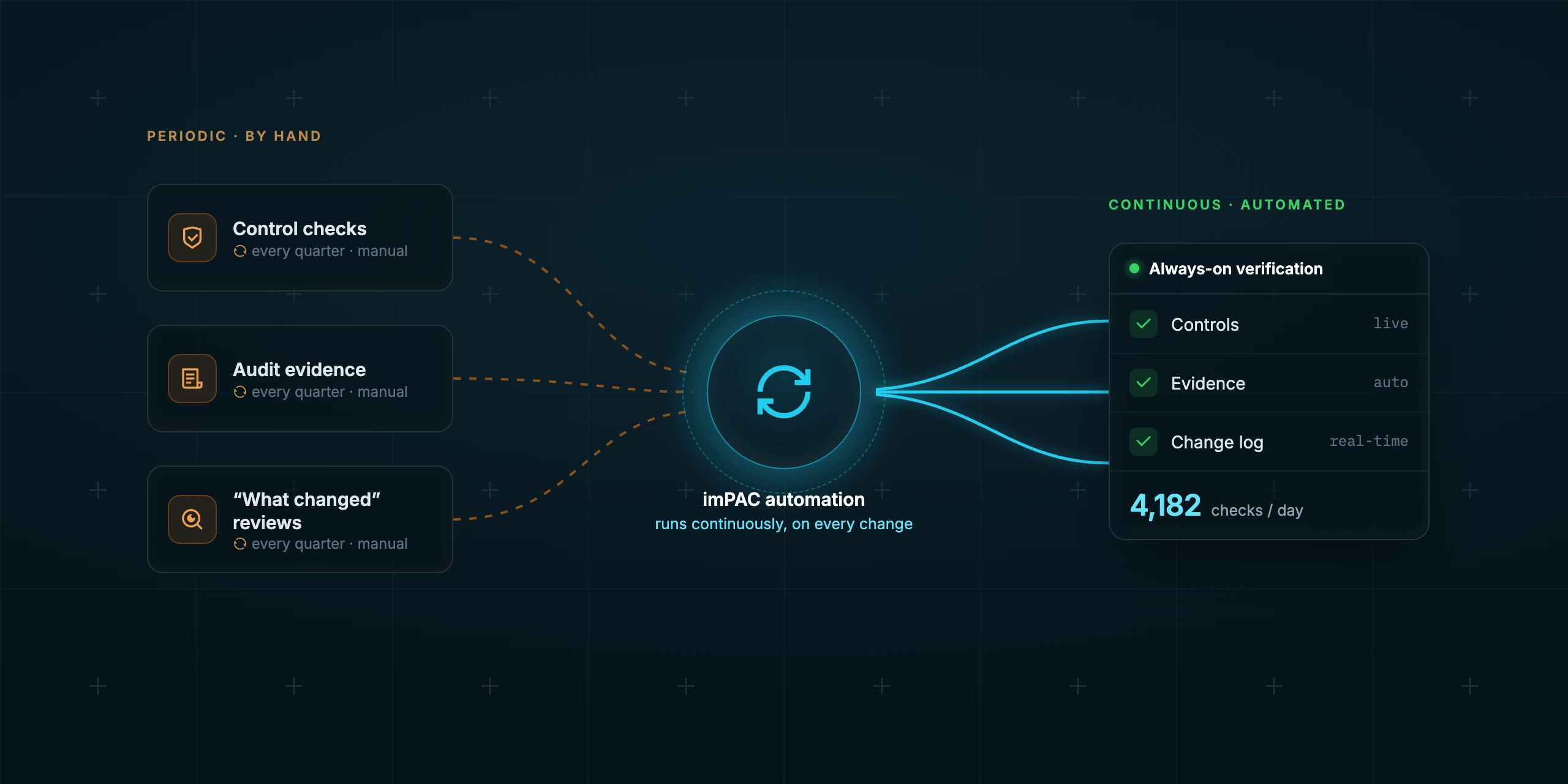
The largest return on optimizing cloud management rarely comes from buying another detection tool. It comes from reclaiming the recurring, manual governance work that quietly consumes cloud, security, and GRC teams every quarter: control checks, audit evidence collection, and "what changed" investigations. Converting that work from periodic, point-in-time effort into continuous, automated checks is where the reclaimed hours, the shorter audit cycles, and the avoided findings come from.
Most teams treat this work as fixed cost. It isn't. It's one of the most optimizable line items in a cloud program, and the return is measurable. Here's where it hides and how to capture it.
The invisible operating tax on cloud teams
Cloud security spending tends to concentrate on tools that answer "what is broken right now": misconfiguration scanners, vulnerability feeds, alerting. Those matter. But they sit on top of a much larger, quieter layer of recurring human effort that never shows up as a product line, and that layer is where a surprising amount of capacity goes.
We built imPAC because we lived this. As cloud engineers, we watched this work eat entire weeks: a few hours here to answer an infrastructure question for security, a recurring scramble there when GRC needed evidence, another fire drill when something changed and nobody could say what. None of it showed up as a tool you could point at. It showed up as people spending a third of their week or more on exports reconciled by hand, screenshots that went stale, and the same checks re-run every quarter because the previous answer had already expired.
It rarely gets optimized precisely because it's distributed. A few hours here for infrastructure, a few there for GRC, a recurring fire drill for security. No single team feels the full weight of it, so no single team owns fixing it.
Why this work resists optimization
Three structural traits keep governance work expensive, and each one points to where the return lives.
It's point-in-time by default. A control check or an evidence pull captures a single moment, and your cloud changes constantly, so the answer decays almost immediately. That staleness is what forces the work to be redone next cycle rather than reused.
It's rebuilt from scratch each cycle. When an auditor asks a follow-up, or a new framework comes into scope, or leadership asks "are we sure," teams often start over rather than reusing prior work. Overlapping frameworks multiply the duplication, so the same evidence gets gathered again and again in slightly different shapes.
It's cross-team and uncoordinated. The person who knows what changed, the person who can pull the config, and the person who needs the evidence are usually three different people on three different tools. The cost shows up as coordination overhead and waiting, not as a tidy invoice.
Optimization, then, isn't about working faster. It's about removing the conditions that make the work recur: making checks continuous instead of point-in-time, making outputs reusable instead of disposable, and making the data self-serve instead of dependent on a chain of hand-offs.
Where the return actually comes from
When you optimize against those conditions, the savings tend to land in four concrete places.
Recurring manual checks, eliminated. Key rotation reviews, backup and resiliency validation, permission audits, and encryption checks across accounts are commonly a one-to-three-week, cross-team effort every quarter. Run as continuous, scoped policies instead, they stop being a quarterly project and become a state you can read at any time. This is usually the largest single line of reclaimed time because it repeats predictably, four times a year, every year.
Audit evidence, compressed. Evidence collection is the textbook case of disposable work redone every cycle. When evidence is timestamped and continuously captured rather than gathered by hand, "show me coverage across last quarter" becomes a query rather than a project, and auditor follow-ups stop triggering a fresh round of engineering work. The reclaimed labor here compounds with every framework you add, because the same continuously captured evidence serves more than one audit.
"What changed" investigations, shortened. When something breaks, the expensive part is usually figuring out what changed and who changed it, not the fix itself. Pulling that from a continuous change log instead of correlating timestamps across separate tools turns an investigation that ran for days into one that runs in minutes, and it lets incident response start from a precise diff instead of a guess.
Findings, fines, and exposure, reduced. Continuous proof that controls were in place at any given moment means more efficient audits and fewer findings. In regulated industries where examinations are onerous and executives can carry personal liability, auto-generated, timestamped evidence is what stands up to an examiner's questions. And because control failures caught at audit time are control failures that ran unnoticed in between, with the global average breach now around $4.44 million, narrowing that window has value well beyond the labor savings.
How to capture it
The return is real, but it isn't automatic. A practical way to go after it:
Quantify the current hours first. Add up what your team actually spends on quarterly checks, evidence collection, and change investigations across infrastructure, security, and GRC. The number is almost always larger than any one team expects, because it's spread across all of them. This baseline is what makes the return defensible to finance.
Target the repetitive and the cross-team work. Optimize the activities that recur on a fixed cadence and that pull in multiple teams. Those have the highest compounding return, because every cycle you remove pays out again next quarter.
Move from point-in-time to continuous. Replace periodic checks with policies that re-evaluate as infrastructure changes. This is the shift that stops work from decaying and forcing a redo.
Make outputs reusable. Define a control or evidence view once and reuse it across frameworks and future audits, rather than rebuilding for each one.
Make the data self-serve. Give GRC and security direct, read-only access to the answers they currently file tickets for. Most of the coordination cost disappears when the requester can pull the answer themselves.
This is the model imPAC is built around: capturing configuration and change across AWS, Azure, and GCP continuously, turning recurring checks into scoped policies, and making evidence self-serve. Across imPAC's own customers, teams report reclaiming roughly 10 to 15 hours a week throughout the year and compressing audit evidence collection from weeks to days. But the point isn't the tool. The point is that the recurring governance tax is optional, and the return on removing it compounds every quarter you don't.
FAQ
How do you measure the ROI of optimizing cloud governance work?
Start with a labor baseline: the hours your infrastructure, security, and GRC teams spend on recurring checks, audit evidence, and change investigations each quarter. Then track three things after optimizing: hours reclaimed, audit cycle length, and the number of findings. Avoided fines and narrowed breach exposure are real but harder to attribute, so most teams lead with the labor and audit numbers.
What consumes the most time in cloud compliance?
Manual, recurring evidence collection. It's expensive because it's both repetitive and disposable: gathered by hand, then re-gathered next cycle because the prior snapshot expired. The work also tends to span multiple teams and tools, so a lot of the cost is coordination and waiting rather than the task itself.
Is continuous monitoring actually worth it versus periodic checks?
The case rests on two things. Periodic checks decay immediately and force rework, which is pure recurring cost. And control failures caught only at audit time may have run unnoticed for months. Continuous monitoring addresses both, which is why the return shows up as reclaimed labor and reduced exposure rather than a single headline figure.
Where should a team start if everything feels manual?
Pick the one or two activities that are both recurring on a fixed cadence and cross-team, since those carry the highest compounding return. Quarterly control validation and audit evidence are usually the highest-leverage starting points.